Elon Musk
Contrast leadership narratives, venture timelines, and cross-industry headlines in one glance.
- Startup milestones vs. philanthropic coverage
- Latest updates on X, Tesla, and SpaceX
Ask any question and instantly see Grokipedia and Wikipedia answers next to each other. Grokipedia gives you fast AI-generated summaries, while Wikipedia provides human-edited facts. Compare both to judge accuracy, depth and how up-to-date the information is.
Browse trending topics to see how narratives diverge. Each shortcut leads to a pre-rendered page that refreshes hourly.
Contrast leadership narratives, venture timelines, and cross-industry headlines in one glance.
Track breakthroughs, policy debates, and research institutes across both encyclopedias.
Compare scientific consensus summaries with futurist lenses and adaptation case studies.
Comparepedia supports analysts, editors, and research teams who need parallel viewpoints without losing the reliability of canonical sources. The layout stays minimal while emphasising speed and licensing transparency.
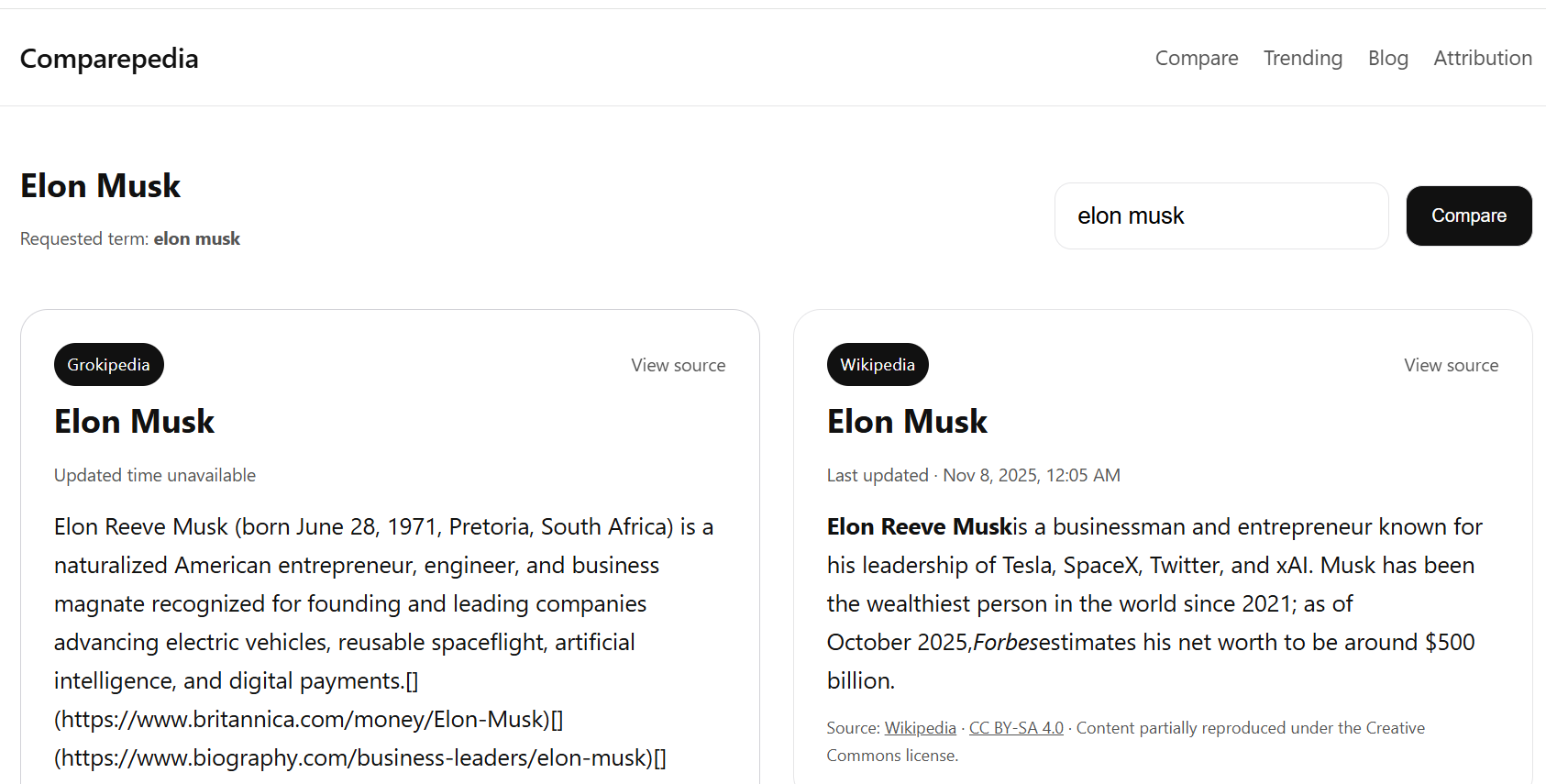
Submit a single query and instantly review Grokipedia and Wikipedia perspectives side-by-side with their latest edit timestamps.
Clean URLs, structured headings, and FAQ schema help search engines understand every comparison for trending topics and evergreen knowledge.
We respect robots directives, rate limits, and Creative Commons rules while delivering clear attribution on every card.
Each search runs a synchronised fetch pipeline that caches results for one hour, enforces three second timeouts, and gracefully degrades if one source is unavailable.
Server-side parsing collects the title, lead paragraph, and updated time when available. HTML is sanitised before rendering to keep the experience safe.
We call the official Summary API, resolve 404 responses with OpenSearch, and store canonical links so readers always land on the source article.
CDN caching and KV storage deliver sub two second loads on return visits, while background refreshes keep snapshots current.
Comparepedia is in open beta and already helps editorial desks, policy researchers, and enterprise teams brief stakeholders with confidence.
comparisons generated in the last seven days across AI, finance, and policy
organisations actively benchmarking Grokipedia against Wikipedia
maximum stale-while-revalidate window for cached compare pages
Snapshots from people who rely on Comparepedia to understand how narratives shift across sources.
"We use Comparepedia every morning to catch shifts in tone before headlines lock in for the day."
Global newsroom, New York"Side-by-side summaries save us hours when briefing committees on emerging legislation."
Think tank, Brussels"Seeing Grokipedia and Wikipedia next to each other is the fastest way to plan messaging adjustments."
Tech company, SingaporeGet more out of every query with these quick reminders.
Grokipedia is an AI-powered knowledge engine that generates answers in natural language. Comparepedia uses it to show AI answers next to Wikipedia content.
When you enter a question, Comparepedia fetches an AI summary from Grokipedia and a matching Wikipedia summary, then displays them side-by-side on one page.
Grokipedia can reflect recent information faster, while Wikipedia may take longer to update but often provides more detailed citations. Viewing both helps you decide which to trust.
No. Comparepedia is an independent tool that simply displays Grokipedia and Wikipedia content together to make comparison easier.